My Publications
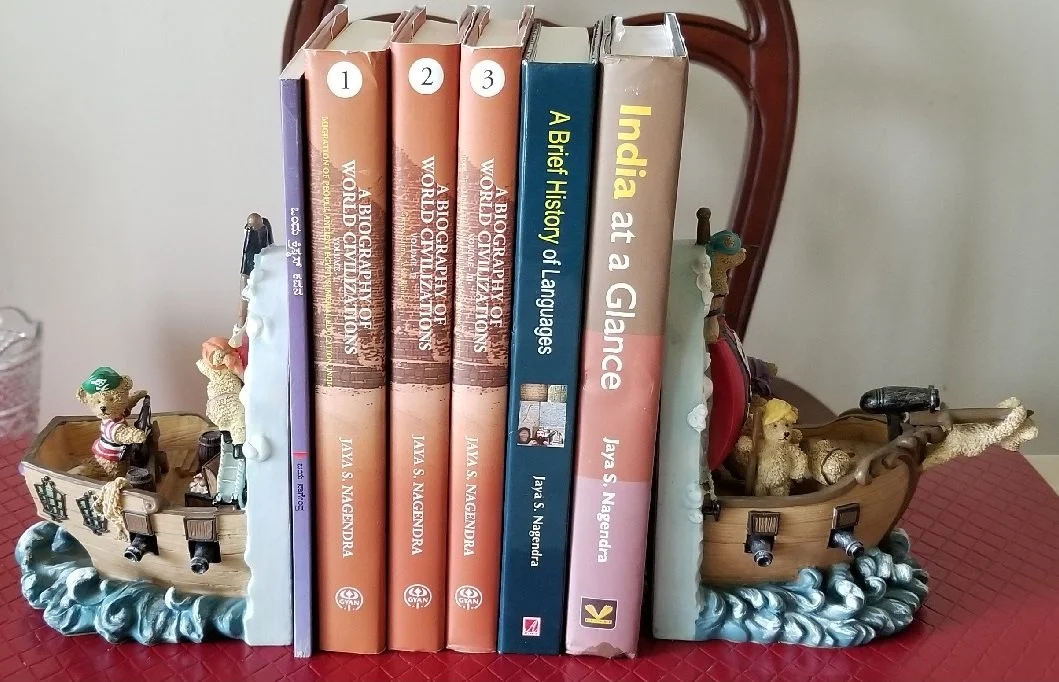
A Biography of World Civilizations. (3 Volumes)
A Brief History of Languages
India at a Glance
ಒಂದು ಕ್ರಿಸ್ತ್ಮಸ್ ಕವನ (Kannada Translation of Charles Dickin’s Novel)

1) A Biography of World Civilizations
An Overview of the Contents
Migration of People: It starts with the time when humans migrated from Africa and reached different parts of the world. People inhabiting remote places, how they built cities, occupied various territories, made wars sometimes for wealth, sometimes for women, and sometimes to spread civilization in barbaric regions.
It has been proved scientifically that our ancestors occupied the earth, continent by continent from the past 50,000 years, and they provide genetic evidence using several scientific methodologies like archaeological, anthropological, molecular clock technique, fossil tests, radiocarbon dating, etc. It also covers the emergence of cultural capacities, human genetic drives, growth of language, and more.
The Ancient Egypt: In this section readers will find that through exploring the ancient Egyptian ruins and tombs, we have been able to learn much about their way of life, Egypt’s creation myth of Amun-Ra, Osiris, and Set; A timeline of the entire reign of the Egyptian dynastic periods from the Old Kingdom to Roman Egypt; details of Hieroglyphic writing system; details on some of important gods including Ra, Amun-Ra, Enki, Isis, and Sekhmet; details on the life of some of the most famous kings including Amenemhet I, Tutankhamun, Akhenaten, Ramesses II and III, and Ptolemy I, and Cleopatra VII; details about the pyramids and temples built; myths of the afterlife; how the water levels of the Nile caused prosperity or disaster; the daily lives of Egyptians, and more.
The Sumer - Ancient Mesopotamia: In this section readers will find Sumer’s incredible history of writing systems. The script known as cuneiform, wedge-shaped signs impressed by reed stylus into clay tablets, appeared first around 3000 BCE. That was the start of writing. Sumer also known as Mesopotamia is recognized as the “cradle of civilization” mainly because of the rise of the city as we know today and the invention of writing in 4000 BCE.
Readers come to understand their Religion, Theology, Rites, and Myth. By the middle of 3000 BCE, hundreds of deities existed among Sumerians. Among them, four deities were most important: An or Anu, the sky god; Enlil, the air god; Enki, the water-god; and Ninhursag, the mother-goddess. Readers also know the Sumerian mathematics, science, calendar, medicine, and technology.
India: In this section readers will find Neolithic period’s agricultural revolution; political and economic growth in ancient India; earlier Mehrgarh, Harappa and Mohenjo-Daro cultures; Mahajanapadas; great empires of Magadha, Mauryas and Guptas; southern kingdoms Cheras, Cholas, and Pandyas; later Mughal period and British rule; Social Reformers who awakened India from its miserable state; and life in India after independence.
Readers also find Ashoka the Great who ruled India around 230 BC. and his contribution to spread of Buddhism and about his inscriptions on various statutes where Social Welfare, Non-violence, Respect to Parents, Freedom of Religious Expression, and all human values he wanted are inscribed, and more.
Ancient Greece: In this section readers will find Greek’s early history and from where did Greek culture come. There are many fascinating and exciting things in the world of ancient Greece, and in this book, readers are going to learn about the history and socio-political structure of the world of ancient Greece, their philosophers, science, mathematics, Greek dramas, wars and the spread of Greek civilization.
Readers will start the amazing journey into the world of ancient Greece with a glance at the rise of Greece in the archaic era. They find out how the world changed in massive ways, and ancient Greece transmissions along with the changing times of the Hellenistic era, and more.
The Land of China: In this section readers will find the history of China’s immense amount of land, more than 3,705,386 square miles ranging from over 50 degrees latitude in the north to below 20 degrees latitude in the south, from the sedimentary plains and river valleys of the east to the hostile mountains, high plateaus , and desert of Tibet and Xinjiang in the west. Kingdoms and empires have risen and fallen on this gigantic landmass. China is famous for its inventions, wisdom, games, and building projects. China is filled with ancient wisdom narrated by many philosophies starting with Confucius, Daoism/Taoism, Buddhism and Sima Quian, a Grand Historian.
China’s contribution to the cultural heritage of humankind is huge and most important. China outshined any other civilizations in the world at some point of time in the past. Many of the world’s greatest achievements in science, technology, philosophy, and art came from Chinese civilization. Its major inventions, which changed the world, includes paper making, Printing, skills, compass, and the invention of gunpowder, and more.
Persia: In this section readers will find the history of Persia’s simple beginnings among the Indo-European nomadic tribes that lived in the steppes of central Eurasia. Initially they coexisted beside several prominent Indo-European tribes. However, a tribal leader, Cyrus began a campaign of conquests around 550 BCE. In just 30 years he laid the foundations of an empire stretching its borders from India in the east, to Greece on the Mediterranean, down to Egypt and Ethiopia, and north to modern Russia. More than 30 different countries and peoples were brought together under the rule of Cyrus, who called himself the “King of the World.”
Readers also learn about Prophet Zoroaster, Darius, Xerxes, Arthakhshatra (the Law of Land), flourishing of Science, and more.
Ancient Rome: In this section readers will find Rome’s magnificent history, and its rise and fall. No other societies and historical periods capture our fascination as much as ancient Rome. It is a story immersed in legend, the rise and fall of monarchy, republic, and an empire filled with colorful and sometimes strange leaders and popular figures. Rome has been the source of inspiration for a many novels, movies, and television shows. Rome was a society that captures our interest even today, more than 1500 years since the fall of the great Roman Empire. Readers also find the story of the Christianization of the empire and its influence, and more.
Europe: In this section readers will find the history of Europe’s dynamic past and present with an amazement. In the beginning, there was no Europe. All there was a long, graceful peninsula positioned like an image of a ship on the world’s largest land mass with no name. To the west sat the ocean which no one had crossed. To the south sat two surrounded and knitted seas, scattered with islands, bays, and peninsulas of their own. To the north sat the great polar icecap, expanding and contracting through the eons like some monster. To the east sat the land-bridge to the rest of the world, waiting for all civilizations to come. Mostly it started to change from the coming of Romans. It went through many stages like wars between neighboring countries, introduction of Christianity, Renaissance, Enlightenment, and Romanticism.
Readers understand that as John Hirst said that in Europe it was not Christianity that is acknowledged but humanism from the Renaissance culture generally. Enlightenment is the dominant influence because Europe was committed to ‘the universal values of the inviolable and inalienable rights of the human person’ and to follow the path of ‘progress and prosperity’. It also saw the destructive forces, and finally forming the European Union, and more.
The Middle East: In this section readers will find the history of the Middle East, the most ancient area of human civilization. Before Christianity, the Middle East consisted of many countries with different names before it was called Middle East such as Egypt, Persia, Assyria, Canaan, Israel, Jerusalem, Judah, Samaria, Phoenicia and Philistia, Yehuda, south, center, and north of the country are called Judaea, Samaria, Galilee, Turkey, Mesopotamia (Iraq), Afghanistan, and most likely Meluha (Harappa). There are numerous references in Sumerian clay tablets about the trade transactions between Sumer and Harappa.
The readers also come to know about Middle East Before Islam, Prophet Muhammad, Muslim Ideologies, Emancipation of Slave Trade, Religion Law, Culture, and more.
Maya and Aztec: In this section readers will find the history of the Mayan civilization and how it had been hidden from the human eye until 1521 CE. Only about 500 years ago, it came to light to the outer world and was soon destroyed by Spaniards.
Readers also understand about the Background of Mesoamerica, how the first hunter-gatherers arrived in America around 21,000 BCE and the city Tenochtitlan and the Aztec builders’ culture was the product of more than 22,000 years of human activity. How Maya built their remarkable jungle cities in the east of Mexico, Mayan calendars, mathematics, architects, mythology, and the destruction of Maya Civilization, and more.
United States of America: In this section readers will find how the history of America began when Captain Christopher Newport anchored his three storm-beaten ships near the estuary of Chesapeake Bay. When he sent a group of people to browse the area, they found noble forests, the ground carpeted with flowers; fair meadows, large tall trees with fresh waters; fine strawberries, four times bigger and better than in England’s; oysters very large and delicate in taste; stocks of turkey nests and many eggs; and an Indian town, where the tribal Indian brought them cornbread and tobacco smoked in clay pipes with copper bowls and how they delighted of seeing richly colored birds, the fruits and berries, the fine fish, and the pleasant scenery.
Readers also find the making of America through Colonialism to Americanism, Independence, the Growth of Democracy, Segregation, Scientific Racism, Progressive Age: New Way of Thinking. Black Issues, Miracles of Age, World War II and America, United Nations, The Space Competition, The Immigration Revolution, Moon Landing, Twenty-First Century America, The Information Revolution, Technological revolution, Not-So-Bright Side of America, and more.
Readers also learn how another side of America is plagued by many social problems, such as racism, drugs, guns, divorce, and psychological disorders. Divorce is putting children’s life into confusions and drug addiction of modern youth is heart-breaking. Growing up in America is a challenging, difficult, and dangerous process.
It is important to know that in spite of its defects, America did make considerable improvements in the national standard of living by elevating the poor to a minimum standard of living, and by opening new doors to a better life to many previously ignored people.
***
2) India At a Glance
An Overview of the Contents
In this book, I intend to give great attention to India’s economic, political, intellectual, literary, architectural, religious and cultural developments that they indisputably deserve. In preparing this book, I have worked hard to provide a complete picture of India as judiciously as possible. It starts from the period when India was attached to supercontinent of Pangaea 225 million years ago, and continues to cover geological formation of India, origin of Hindu civilization, Vedic, Epic and Puranas period, rise and spread of Indian philosophies such as cosmic questions of Hinduism, non-violence of Jainism, act of compassion towards humanity of Buddhism, Indian philosophers and social reformers. It also covers Neolithic agricultural revolution, political and economic growth in ancient India, earlier Mehrgarh, Harappa and Mohenjo-Daro cultures, Mahajanapadas, great empires of Magadha, Mauryas and Guptas, southern kingdoms Cheras, Cholas, and Pandyas, later Mughal period and British rule, Social Reformers who awakened India from its miserable state, and life in India after independence. The incorporation of all major events happened in the Indian subcontinent where economy, art, culture, science and language flourished in its golden period and modern Independent revolutionary period is a noteworthy subject in this book.
Secondly, I have classified each Part chronologically as much as possible for organization and clarity. Part I is organized to demonstrate India’s geological description, its climate, people, languages, etc., Part II is organized to exemplify Ancient India and Origin of Hindu Civilization, Part III is organized to illustrate Mughal Empire, Part IV is organized to show Colonial India, and Part V is organized to describe India after Independence.
To keep the book fresh and appealing, I have added religious developments with special emphasis on their popular and social aspects, extending from ancient to modern times. The reader will also find material on many topics, notably the Greek, Persian, Huns, Sakas, Mughal and Colonial invasions on India, ancient empires, dynasties and rulers, their contributions to India in science, mathematics, literature, and architecture.
The maps presented in the book are intended to assist the reader to know India’s geography, rise and fall of its empires and history. The physical features of India have shaped its history in a fundamental way.
Finally, the illustrative component including maps containing geological formation of India since Pangaea, seismic zone, rivers, ancient empires and present-day India are included. Illustrations of ancient coins, architecture and paintings of earlier times come alive.
I have also tried to mention how early intellectual people actually worked and thought. I have quoted extensively from a wide variety of primary sources and have demonstrated by quotations how historians filter and evaluate evidence. It is my hope that the primary quotations, carefully fitted into their historical context, will give the reader a sense that even in the earliest and most remote periods of human experience, history has been shaped by individual men and women, some of them great aristocrats, and other ordinary folks.
The book ends with some extracts from the Constitution of India. Its purpose is to educate Indian people to get acquainted with citizen’s fundamental rights, and citizen’s duties and responsibilities to the country.
In the end a reference list is provided to help the readers know where to turn to continue thinking and learning more about Indian civilization.
Honest attempt has been made hoping this book helps to understand Indian history, geography, culture, philosophy and every aspect of India and its related subjects.
***
3) A Brief History of Languages
An Overview of the Contents
This book A Brief History of Evolution of Languages is aimed to assist as informative and basic understanding of world languages. This book is meant not only for students, but also for the general public who have a thirst for knowledge. Learning does not stop at schools or colleges. Learning should continue as long as we exist. Language is a remarkable factor in human history. Imagine a world without language, what our fate would have been today.
The book “A Brief History of Evolution of Languages” is about the evolution of languages in the history of humankind. It describes numerous hypotheses regarding when, where why and how the human language emerged. It starts from features of the human vocal tract, formation of voice box, Neocortex areas that are responsible for controlling the muscles of the face, tongue, mouth, and so on covering primary characteristics of human language.
The book traces various theories for the cause of origin of languages, such as gestural theory, continuity theory, discontinuity theory, Max Muller theory, and others.
Language’s social aspects are addressed at each chapter. Since Home erectus, our species have distinguished themselves from other creatures by forming societies based on speaking abilities.
When we learn how to speak in our childhood, we take it for granted without knowing how the language evolved and how we have reached perfection in language. My interest in different languages and vast research in the field of languages I made to prepare this book made me intellectually rich. It is a thrilling experience because language is not a remote subject, it is our daily business to speak. Therefore, I decided to share my joy with others also.
I have written about several languages in this book to enumerate relevant matters to present information about the evolution of languages. Please do not assume that I know all these languages thoroughly. In that sense, I know some languages in basic form and many with sufficient knowledge. It makes it easier to relate and compare different tongues and find similarities in languages and scripts. It is impossible to acquire a practical knowledge of all languages. However, a short list of vocabularies and fundamentals of grammar is needed for the purpose of this work. It enables a reader to make the best of this fragmentary information just like a student in any discipline learns his/her lessons from smallest fragments of his/her subject or from accidental encounters with people or places, or from discussions with even from our common fellow beings. No one expects a botanist to be a skilled gardener, or the geologist to be a miner, or an astronomer to be an astronaut.
Distinct features of this book are the description of origin and evolution of languages; primate language; the importance of Broca and Wernicke portions of the Neocortex in the brain; theories of human language development, primary characteristics of human language; animals communication system, animal intelligence, features of human language in animals; ancient languages and their scripts, living and extinguished languages and their scripts, and modern languages; introduction to Indo-European and Indo-Dravidian languages; and the contribution of writing system.
It also touches animal communication validating their possibility of developing language with relevant examples.
The book has covered more than 20 main living and non-living languages each containing its origin, scripts, grammar, inscriptions, how literature helped the language to develop its maturity, and so on. Six languages, German, French, Spanish, Italian, Hindi, and Japanese have daily usable phrases and basic grammar.
Recognizing that writing is the pathway to wisdom, the book explains the wonderful history of writing also. In this section, it is discussed how the ancient people used scripts to convey the message beginning with knot records, tallies, graphic symbols, hieroglyphic, cuneiform, Indus Valley Writing, Aramaic writing, Chinese writing, Mayan writing, Greek writing. And the development of writing materials such as papyrus, parchment and finally the fantastic Paper also discussed.
The Some Living Languages section provides a brief history behind each specific language and an example of a poem at the end.
The Basic Grammar section provides fundamental grammar rules for each living language. It is an introduction to grammar.
The Simple Phrase section deals with phrases. This section consists of simple useful phrases for travelers and to everyone who likes to know about other languages.
The Alphabet Pronunciation section includes the alphabets of each language, its pronunciation, examples, and guide for pronunciation.
Appendix section provides equivalent meaning for numbers, days, months, seasons, and colors in each language.
-JN